

How many trees can be identified in London in one day?
Leaves of London


One of the hardest things I found when I first moved to Mile End nearly a decade ago was the lack of easy access to nature. Not that I grew up in true wilderness. Hastings is far from it. But within ten minutes I could be in a cliff-edged country park, walking through ancient woodland, past steep glens and an abandoned quarry.
I loved it so much that during my school years I would take my textbooks into the nature reserve and revise for my GCSEs from a hammock. This usually led to confusion, and some mockery, from my peers.
Arriving on Mile End Road, with its traffic and horizon of brick and glass, was therefore a shock to the senses. And yet, a decade later, I am still in London. Its cultural and social pull has a way of holding on to you. Over time, though, I have found ways of reconnecting with nature in the city. It is easier than you might think.
In my experience, the city’s most overlooked, or perhaps more literally ‘underlooked’, natural asset is its trees. You can seek out canals, parks or swimming ponds, but trees are everywhere.
When I began looking into this more closely, I was surprised to learn that London is home to an estimated 8.4 million trees, with over 20 per cent canopy cover, enough to qualify it as an urban forest. It made me wonder how well I really knew them.
Around the same time, I had started asking people across the city about their favourite trees. What began as a passing curiosity gradually became a film project. Leaves of London explores the relationships people form with the trees around them, and more information about the film can be found at the end of this piece.
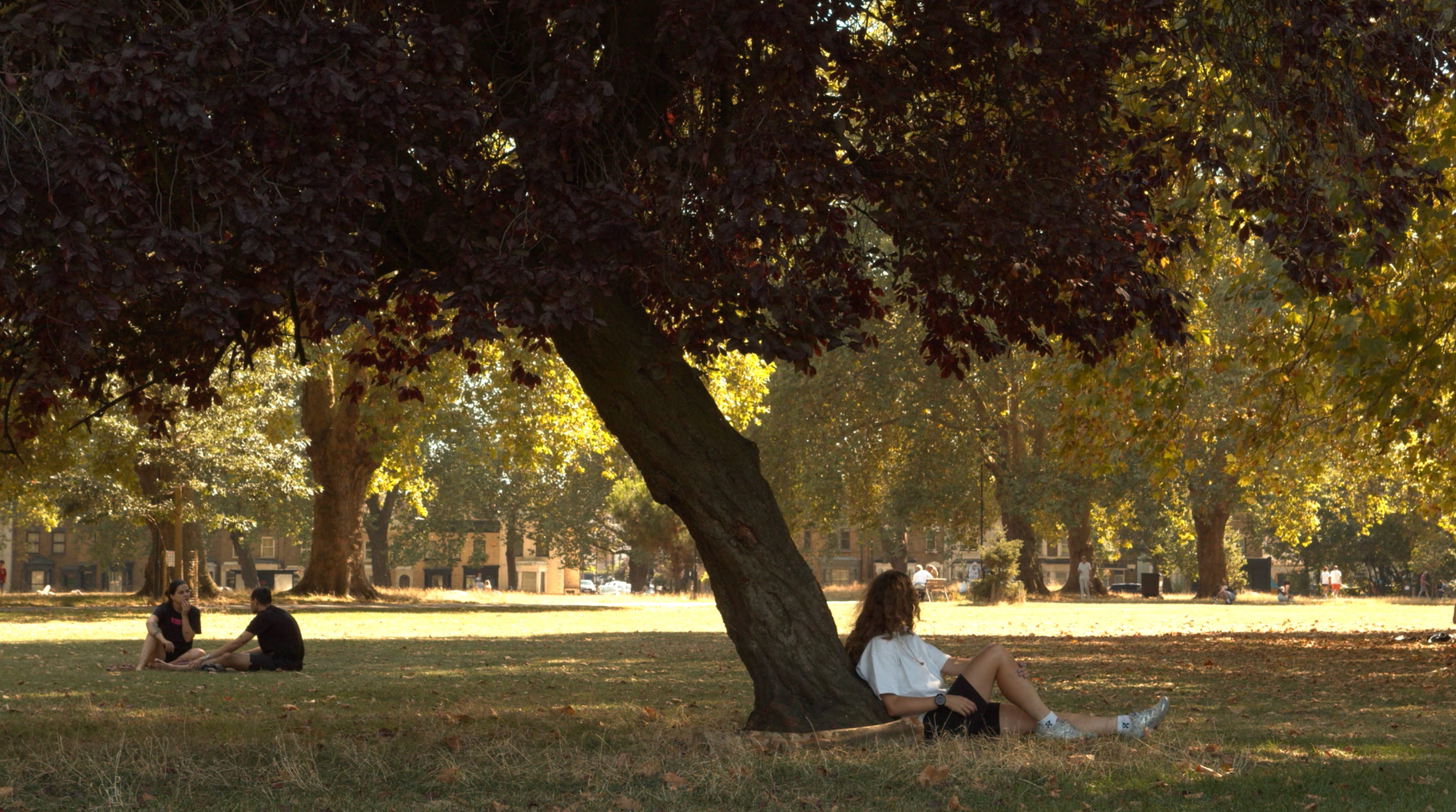
While filming these conversations, I set myself a challenge. On one of the shoot days, how many trees could I identify in a single day?
I set an arbitrary target of 50 and began, just as arbitrarily, among the terraced streets near Clissold Park. My starting point was simple. I knew there was an oddly shaped eucalyptus on Ayrsome Road that I had always liked, shown to me by a friend on a run. It leans so precariously that locals have propped it up with bricks to stop it from falling.
From there I walked towards Dalston Kingsland. It was striking how many different species appeared along these streets. Small ornamental trees, often non-native, seemed to be favoured for their size and colour. Even along short residential stretches I quickly approached twenty distinct species, including a Persian silk tree, a golden rain tree and a towering palm.
I then took the Overground to Hampstead, where I was meeting Yaz, a friend who had agreed to be interviewed about her favourite tree. Strategically, it felt like a good move. When you think of trees in London, you think of its great parks.
Leading into Hampstead Heath from the station is a line of London plane trees, perhaps the most recognisable in the city. Planted widely over the past few centuries, they are known for their resilience and ability to withstand pollution.
The Heath, however, presented a different challenge. The trees were beautiful and abundant, but more uniform. I found willows around the ponds, along with oak, elder and poplar, but the variety I had seen earlier was less obvious.
After speaking with Yaz about her favourite, a dead oak in the north-west corner of the Heath, I moved on towards Homerton for another interview. Walking down towards Millfields Park, I picked up a few more from front gardens along the way: a fig, an ash and a sweetgum tucked behind a fence.
After meeting Iona and hearing about an improbably slanted plum tree, I continued into the Lea Valley, following the river. By this point I had identified around thirty trees and was unsure how many more I would realistically find. Still, I kept walking. It is one of my favourite stretches of the city, and I have even seen kingfishers there.
I added a few more along the way: another variety of oak, a hawthorn, several willows and ornamental plantings in the Olympic Park. But as I approached forty, it began to feel as though I was running out of options.
Slightly against my instincts, I took the train to Liverpool Street and began walking back towards Hoxton through the City. I was curious to see whether the financial district might offer anything at all.
To my surprise, it offered quite a lot. An olive tree outside the station. A line of magnolias. And, through the glass of an office lobby, a ficus bonsai. As I tried to get a closer look, I was promptly intercepted by a security guard who made it very clear that I would not be stepping any further inside.
After a brief exchange, and under what felt like the watch of an unofficial bodyguard, I decided I had seen enough. Perhaps not technically a tree, but given the effort required to identify it, I decided it counted.
After nearly 30,000 steps, I was ready to call it a day. Then, near Boxpark Shoreditch, I spotted an apple tree already heavy with fruit. That pushed me closer to my target.
Determined to reach fifty, I made one final detour to Haggerston Park. This small park, laid out in the 1950s as a formal garden and somewhere I walk most days, turned out to be the perfect place to finish. It is lined with fastigiate oaks, Italian cypress and horse chestnut trees.
By the time I left, I had identified fifty-three.
Since then, the number itself feels less important. What has stayed with me is how the challenge changed the way I move through the city. Streets I had walked for years began to feel different, and watching certain trees change through the seasons since that day has been quietly remarkable.
The conversations I had across London also deepened that shift. Hearing people speak about their favourite trees revealed how often these overlooked parts of the city are tied to memory, routine and a sense of place.
Leaves of London explores some of these relationships in more detail.

Leaves of London: inaugural screening and panel discussion
Leaves of London will have its first screening at the Castle Cinema on Saturday 23 May 2026, from 10.00am to 12.00pm.
The film follows four stories, each centred on a different tree and the person who returns to it, exploring connections between people, place and nature in the city.
The screening will be followed by a panel discussion on the role of trees in London, from environmental and ecological perspectives to their cultural significance.
Speakers include:
John Rogers, writer and filmmaker
Tim Webb, London Parks and Gardens Trust
Mary King, Trees for Cities
Adam Cormack, Woodland Trust
Tickets are available via Eventbrite: Leaves of London screening & panel discussion
 | A guest post by
|